Exciting Changes Happening Everywhere!

It has been a *crazy* time in the land of Julia, but I wanted to  update my readers about a few of the things going on!

New Book!
My first book, based on the Modernizing Markham blog and project I did for the Center for the Book, is now out through Candle Light Press! It’s going to be the first in a series of books that deal with the works of Gervase Markham and the foodways and domestic culture of 17th century England. I’m excited about it because I love the press, and the project allowed me to pull in learning from my work with social media and blogging along with work in book art and history. I’ve got a few ideas for what the next books in the series might be, but I’m always open to suggestions too!
You can purchase the book here, or here, although as always I encourage folks to first try to order books through local indie booksellers.

Moving (again!)
Wait, you say, didn’t you just move to Tallahassee 2 years ago? Well, yes. And I love it here–I’ve made some of my closest and most incredible friends, grown as a scholar within the best department I could imagine being involved in, and had plenty of fun experiences. I’ll definitely feel homesick for this place, but I’m moving on in late May to go to New York in order to work on my dissertation research and to live in the same city as my partner.
Right now I’m selling off my artwork and most of my possessions, and I’m looking to adjunct or work in a research facility to bolster my income while I work on the next steps to my degree. We’re planning on living in Brooklyn, so if you’re in that neck of the woods, let me know! I’m always up for librarian/PhD meetups!

Housekeeping
Last, I wanted to solicit some input about my site: I’m considering making another page on my site that has resources for recent grads/LIS students. One of our faculty members has done a similar thing, and I think it’s an awesome idea and a great way to continue to connect with and help students after the semester ends. I’m not sure exactly what would go up there yet besides his site, some things from Hack Library School, and INALJ, but I’m curious if any students out there would find that helpful or if any students/instructors have tips on what should go on such a page. If you have an idea, please leave it in the comments!


Upcoming presentations

Are you going to ALISE this year? So am I! I’ll be presenting during session 4, which is from 8:30-10:00 AM.
The title of our panel is: Questions Are Never Neutral: Examining the Occupy and Tea Party Movements as Exemplars of Information Research and Everyday (Political) Life.
I’ll also be doing some things with JELIS, the journal I intern for, and I’ve put my CV in the adjuncts folder at the conference. If you see me around, say hello!

Rebuilding Libraries After Hurricane Sandy

Update 11/8: So far, we’re up to $80 between all three libraries. I’ll keep updating totals as more people donate!

It has been a little while since I’ve gotten the chance to update here, but there are good reasons (I promise!) that I’ll be announcing to you all soon. The recent hurricane, though, was enough to knock me out of hibernation. It has been so devastating to watch the impact of the storm on communities around the East Coast, and particularly hard to see the devastation in my future home. I am absolutely in love with that area of the country and with all the people I know there, and have been trying to think of ways to really make an impact from afar. I’ve donated to the Red Cross and a few other groups, but the thing that keeps coming to mind is the success we had as a community of professionals in raising funds after the Joplin tornado.

So, this message is a plea to everyone in libraryland (and everyone who loves libraries) to show that kind of support to libraries in need. The staff are working like crazy to keep libraries open and serving as the most effective community spaces possible by providing resources, bringing in trained experts, and giving people a place to charge their phones and get out of the cold.  When the library isn’t open, library staff are going mobile to bring resources to their communities.
This is a time when our colleagues are really shining, and showing why their libraries matter to communities. I know this is something we would all do in the same position, because we love our patrons and we love our libraries, and I’m hoping we can all come together from afar and help those communities out. There is an excellent article in American Libraries Direct  that helped guide me to some resources, and I’m listing them here, along with opportunities to donate to individual libraries that have listed immediate needs on their websites. If anyone knows of other  libraries in impacted communities that are taking donations, please share them in the comments. It would be great to have our library love reach as many people as possible!

Libraries in need of assistance

Queens Library: Several libraries were damaged during the storm, and many materials were lost. These libraries are in some of the hardest-hit areas, which means their patrons need everything from FEMA assistance to outlets to charge their phones. Staff have taken bookmobiles out to bring resources to patrons and are doing some really incredible work, but they need help to rebuild their collections. Their library foundation has a donation page where you can donate using a credit card.

Brooklyn Public Library: BPL has not set up a disaster-specific donations page, but some of the branches sustained damage during Sandy, according to the BPL website. The library has a page for making donations which allows you to specify where you want to gift to go (I would recommend selecting ‘where it is most needed.’) If anyone knows of additional funding needs for BPL (or a recovery-specific funding site), please let me know.

New Jersey Libraries: The New Jersey Library Association has set up a donation page to raise funds for libraries around the state that were damaged during the storm. Like the other libraries, these folks are working hard to help communities recover, and need assistance as they begin to rebuild.

I’ve donated to each of these sites, and I hope you’ll join me today in helping out our colleagues in need. Our field is filled with passionate and awesome professionals, and I’m looking forward to seeing that in action! Once you donate, you can tweet your amount using the hashtag #sandylibraries, leave it in the comments on this post, or send me an e-mail with the amount (JuliaCSkinner at gmail dot com). I’ll update the totals as I get them in! Remember, any amount (even $5) helps–and enough small donations really add up. Thanks everyone!

Update 11/8: Reader-Suggested Sites

American Library Association site for how to help U.S. libraries after a disaster.

New Funding Opportunities

It has been a long, long time since I’ve gotten the chance to post these (sorry everyone!) I’ve run across some good stuff this week though, so I thought I would share them. Since the international opportunities are across many disciplines, I’ve decided I’m going to start organizing those items by field rather than lumping them all together, but other than that these are organized the same as my earlier posts. Enjoy!

Arts
The Women’s Initiative: For a photojournalistic project dealing with violence against women.
Artist Enrichment funding: Through the Kentucky Foundation for Women.
Berlin Prize in Music Composition: American Academy in Berlin.
Manhattan Community Arts Fund: For arts projects serving the lower Manhattan area.
Young People and the Arts: To support professional development (Australia).

Humanities and Social Sciences
Marshall/Baruch Fellowship: For those studying U.S. military or diplomatic history.
University College Cork: Accepting applications for a PhD in digital arts and humanities (Ireland).

Library & Information Science
 
AAHSL Leadership Program: For those seeking leadership positions in health sciences librarianship.

Sciences
Theodore Dunham, Jr. Grants: For research in Astronomy.
Stony Wold-Herbert Fund: For people in the New York City area researching pulmonary disease.

Other Opportunities
The Bicentennial Swedish-American Exchange Fund: To allow a working visit to Sweden.
North Carolina Scholarship: Through the Swedish Women’s Educational Association.
Mott Foundation: Funding for projects related to civil society, the environment, Flint, MI, and to the elimination of poverty.

Cat Librarian Calendar is Happening!

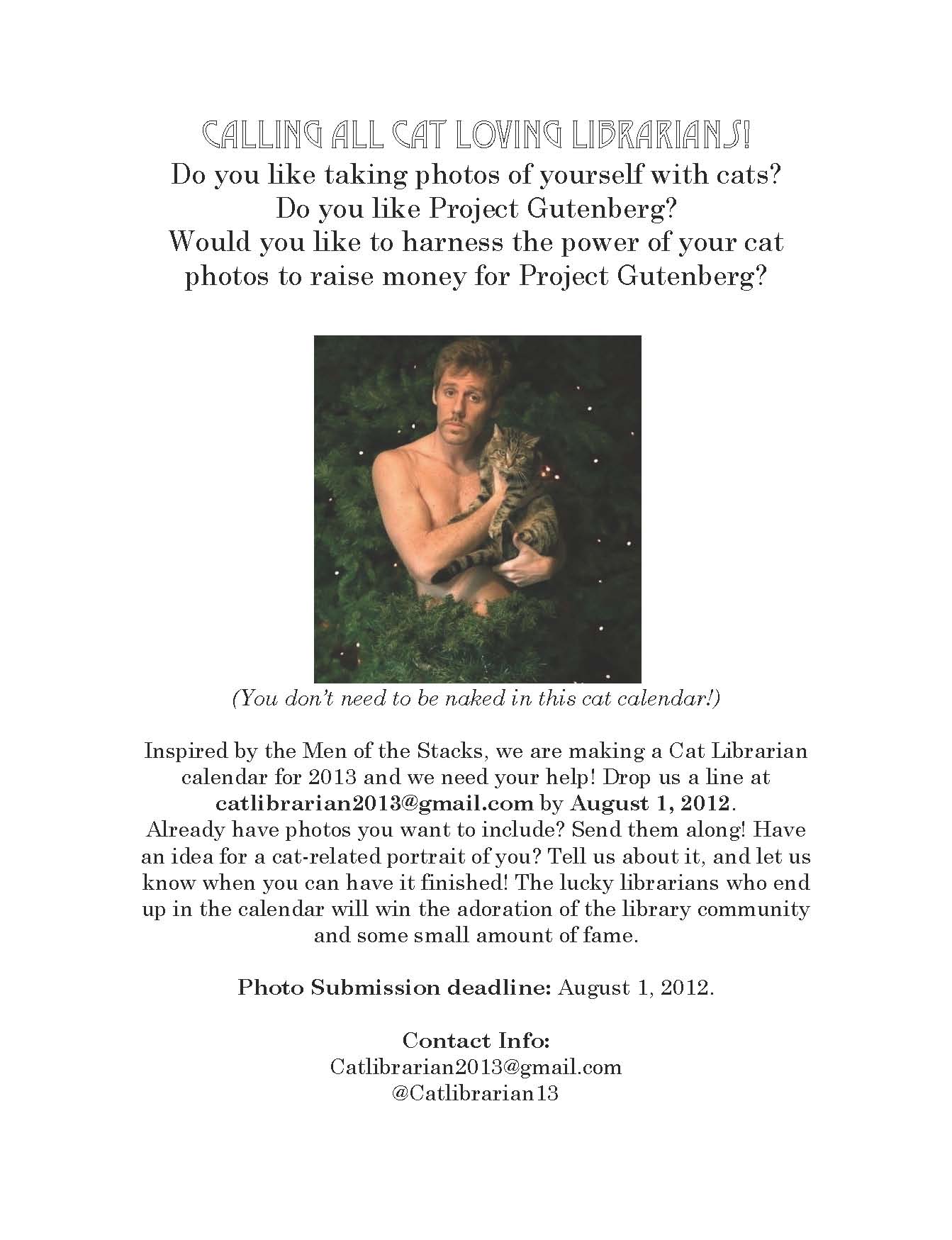
As some of you already know, I’m teaming up with the talented Emily Drabinski to produce a calendar to raise money for Project Gutenberg. We were inspired by the success of Men of the Stacks last year, and thought it might be a cool thing for the library community to get involved with more widely. To that end, we’re asking for photos from folks who are a part of our little niche: people in libraryland who love cats! So, if you’re a library professional and have a photo of you and a cat, send it along to us! We are hoping to make this calendar the best it can be. And spread the word–the more people who know about the calendar, the more money we can raise and the more wonderful pictures we will see!

Learn more about the calendar project on the Cat Librarian 2013 website and Facebook page.

Submit your photos to catlibrarian2013@gmail.com by August 1st!

11 things–(un)related to libraries

Yesterday, Heidi Schutt (@hfkittle, for all you librarians on Twitter) wrote a post telling her readers a bit more about herself, and so I am doing the same. Here goes!

11 random things about me

 1. The only hard thing about moving to Tallahassee was the realization that I could no longer walk everywhere.
2. My favorite non-LIS job was bus driving.
3. I like to spend my days off  cooking, gardening, and canning food.
4. I don’t know how to ride a bicycle.
5. I have three cats: Queequeg, Gir, and Mouse (a.k.a. Professor Butterscotch)
6.  I am working on three different research projects right now.
7.  At one point, I planned to move to England and open a bookstore/coffeehouse.
8. I prefer vintage clothes to new clothes.
9. I still miss living near the mountains (I grew up in Boulder, CO).
10. I like a really wide range of music: everything from Afghan folk music to early Metallica.
11. I am hoping to have the rest of my back tattooed by the end of the summer.

11 answers to 11 questions

1. What vegetable could you NOT live without? I don’t think I can narrow it down to even a handful of veggies. The only one I don’t really like is green bell pepper, and even that is OK if it’s cooked in something.
2. What’s your earliest memory of a library? I loved my elementary school library! I remember trying to raise money for the library by selling cookies or lemonade or something. I only raised $2 and some change, but I was super proud of myself. Especially when they published a little blurb in the school newsletter about it.
3. If you could revisit somewhere you’ve already visited, where would you go and why? This is another difficult one, but probably the Scottish highlands. It’s such a beautiful place and I feel really peaceful when I’m there (it’s also where a good chunk of my ancestors are from).
4. What 2 people would you take with you to revisit that place? These are all such hard questions! I can think of a handful of friends and family right off the bat that would be excellent travel partners. To go to Scotland, I bet it would be fun to take my mom and grandma.
5. Do you prefer to swim in lakes, a pool or the ocean? Why? Lakes and/or ocean, because it usually coincides with a fun outdoor activity (like camping) that I’m engaging in with people I love to be around.
6. Are you an early bird or a night owl? I can be either: my sleep schedule switches around quite a bit.
7. When and where did you learn to ride a bike? Some time in the future…
8. You and only you are being sent to an island furnished with food, water and shelter for a lifetime – what 3 comfort items do you bring with you? My computer, some setup to access the internet, my pets (unless they don’t count as comfort items, at which point I would say my favorite books).
9. What’s your all-time favorite television show? Probably Monty Python’s Flying Circus. Or Red Dwarf.
10. Chocolate or Vanilla? Chocolate. The really dark and yummy stuff.
11. What’s your favorite board game? I haven’t played board games in quite a while, although I feel like I enjoyed Chutes and Ladders and Monopoly when I was a kid.

11 questions for my fellow bloggers

1. Have you ever felt a strong pull to travel to a certain place? Where? Did you end up visiting?
2.  What was your favorite job outside of a library? Why?
3. What author would you want to sit and have a conversation with? Why?
4. What are the three things in LIS (or whatever field you consider yourself a part of) that you are most passionate/excited about?
5. Have you ever published any of your writing?
6. Do you like penguins?
7. Do you have tattoos?
8. Which of your gadgets (phone, tablet, etc) do you use the most?
9. What was your favorite subject in school?
10. What US town or city do you most want to visit?
11. How much time do you spend outdoors in a given week?

Now it’s your turn to write a post: write 11 things, answer my questions, then write new questions to share. I’d love it if you shared the link to your post with me when you’re done: I feel like I know a lot about the professional lives of my fellow libraryland writers, but less so about your lives outside of the library!

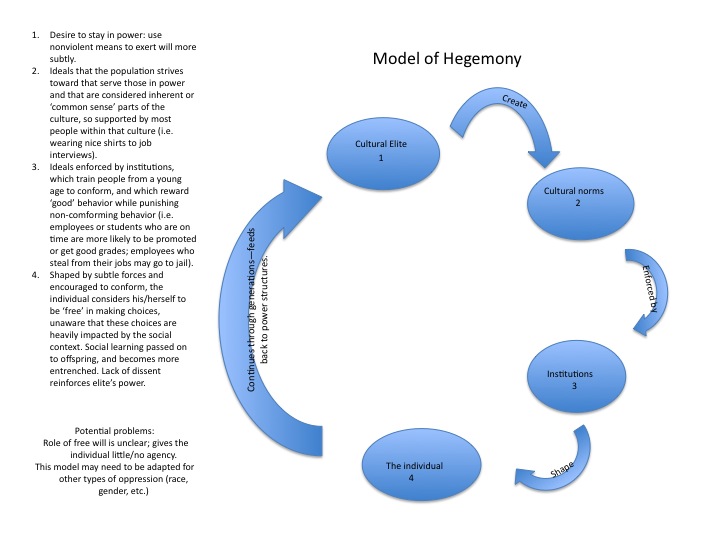
Visual Model of Hegemony

I am taking an LIS theory class this semester, and since we could use just about any theory we wanted (which would be hard not to do, given how interdisciplinary our field is!) I decided to go with the theory of hegemony. I’ll spare you the contents of my papers on the history of the theory and just focus on the model here (if you’re curious, the International Gramsci Society has some good resources, and I’m more than happy to share citations and such with anyone who has questions).
One of the reasons I love the theory, and the main reason I chose it, was that it was created by Antonio Gramsci, who started out in academia then left that life to pursue another career (as an activist). I feel like having both those perspectives and types of training informing one’s work makes for much more well-rounded scholars and keeps us from being so trapped in our own little world that we can’t easily engage with the world around us. I wrote a post on how my experiences in the service industry have shaped me as an academic that talks a bit more about this. I also love how the theory has been applied to so many research questions and types of inequality across many different fields, which shows its usefulness but also made it a bit tricky to pin down and define in a short paper. I tried, and I came up with this model that I wanted to share. It’s the first model I’ve made, so I suspect it’s far from perfect, but I would love to hear what you think–what looks good? What might I consider changing? Are there things you would add/take away? Major points that were missed? Would the model look the same for all types of inequality?


The model is held under a Creative Commons attribution-noncommercial 3.0 unported license (just like the rest of the site). Please share it with colleagues/students/whomever, just give me credit if you do!

Exciting Happenings

A quick post to share a few exciting things:

My brief article on Modernizing Markham has been published in this issue of the Indiana Food Review. More exciting news about that project to come later.

I’ve joined the circus! Seriously! We have a circus class here, where I’ll get to learn the different performance and rigging activities I could do. I’m hoping I’ll find one I really love so that I can audition for the regular circus and get to perform while I’m here. If you want to check out the FSU Circus, go here.


How Our Past Impacts Our Present: Where do Info Pros Come From?

I’m working on finalizing a super awesome project (TBA soon), and it has gotten me to thinking about the different ways my haphazard professional past has actually worked to my benefit as an academic. I’ve also been wondering how other information professionals’ pasts have impacted either the decision to enter the field or have proved beneficial once a library (or academic, or whatever) job has been landed. How have your experiences shaped who you are as a LIS professional? What experience do you think everyone should have?

A bit about my background
I won’t go too in depth here, but this is a (very) brief overview: I grew up in Boulder, CO, and moved to Iowa for school. I originally went to college for art, changing my mind after a year to Psychology  so I could do victim’s advocacy at a rape crisis team. While getting my BA, I went to one private college, one community college, and one state university. I applied to school for PhDs in Psychology after I got my BA, but didn’t get in to any of them. During my undergrad years, I worked in a cafeteria, a call center, managed a convenience store, and got a job driving buses, and took a couple breaks/part-time semesters (meaning that the degree took 2x longer to get than people say it’s “supposed” to). I took a break after school and flip-flopped between working as an assistant manager at a yummy coffeehouse/eatery/bakery, and driving buses. When I went back to school, it was to get my Master’s in Library & Information Science and my Center for the Book certificate, although I still worked driving buses (except for a 6 month medical leave that was filled with unpleasantness) and in the state historical society. Before I moved here to start my PhD, I spent my last summer (sniffle) driving buses. Now I work as a teaching assistant in my department!

Crossover skills
Putting up with stressful situations/unpleasant people: I firmly believe that everyone should spend at least a year working in the service industry. Not only does it help you appreciate the complexity and sometimes stressful environments that go with service industry jobs, but it makes you more likely to be pleasant to the people you encounter in restaurants/on buses/whatever, and to be calm under stress (being slammed during lunch rush, driving a bus in a blizzard, etc.). After spending some more time in the academy, I’ve recognized the value in staying calm and focused in that environment too. The people I encounter in school are all awesome (and most of the customers I had in my old life were awesome, or at least just fine, too), but I still feel the stress of having an article rejected or somehow being told my work isn’t what it should be. I doubt I would explode on anyone or crumple into a heap without my service industry background, but it definitely makes it easier to recognize that work-related unpleasantness is temporary and to take it in stride.

Remaining interdisciplinary: One of the biggest bonuses of having a patchwork background is that it keeps my mindset broad. Focusing to an extent is good, but if I can’t see the forest beyond the one tree I’m studying, my work isn’t going to be nearly as interesting (for myself or for my poor committee who will be subjected to reading it). It also allows me to draw connections I would not have thought of otherwise–almost every article I read on information seeking reminds me of my customers.

Trying new things: This was something the fine folks at Cambus helped me get better at. I’ve always loved to try new things, but after working there, I found it even easier to say “I want to try doing that thing” and then actually go do it. I applied for the job on a whim: I was broke and needed money, but I wasn’t expecting that they would actually hire me (especially when I almost fell backwards out of my chair during my interview). But they did, and I found out I really loved it. That mindset is how I decided to try my hand at grad school, how I decided to take a class in “Circus Activities” this fall, and how I decided I want to spend much more time traveling (a goal I’m still working on).

Keeping up with hobbies and enjoying down time: Sometimes, I really miss my service industry jobs. I miss making coffee and food for people, I miss spontaneous conversations with whoever walks in, and I miss driving buses. I don’t doubt that I made the right career choice, but my yearning for an environment where I’m being creative with food makes it easy for me to find the time to actually engage in those activities (i.e. having a hobby, something that can easily get lost as a PhD student). That’s not to say I don’t get my work done–I work more hours as a PhD student than I ever did in the industry, but I’m getting a little better at maintaining a work-life balance. I also love keeping in touch with my friends outside of libraryland and academia not only because I have *incredible* friends, but because it gives me the chance to talk with people about something besides school/work. Not becoming too insular (and losing touch with people outside of our discipline, which would be most of the people in my life) is always a good thing.

This is probably an incomplete list, but I want to get feedback from my friends in libraryland/service industry/the academy/etc. What unexpected skills did I miss? What experiences have you had?