Dean’s Colloquium Series: Howard Rosenbaum

Today Howard Rosenbaum came to speak to SLIS about bringing educational entrepreneurship into iSchools. Like I did on Monday, I live tweeted the talk and compiled it into this story for people to see. There are more talks coming up, so make sure to stay tuned and leave your comments (about this or the other talks) here and on Twitter!


Dean’s Colloquium Series: Caroline Haythornthwaite

Yesterday was the first in a series of colloquia dealing with iSchools in the 21st century. I tweeted the talk under #fsuslis13, and ended up (as always) learning a lot and having some great conversations about the field. Yesterday’s speaker was Caroline Haythornthwaite, whose work I’ve admired for a while and who was really great to meet and talk with in person. She brought up some ideas I really liked, about fast information and slow information, and about the cyclical nature of the data-information-knowledge lifecycle (rather than thinking of it as linear). As she said during lunch with the doc students today, it’s important to look at the areas between those iterations and to think about how they inform each other.

I’ve compiled my tweets (available here), and would love to hear from readers about what you think of her ideas. Anything I missed? Anything that sparks your interest or that you agree (or disagree) with as a researcher or practitioner? We have a few more speakers in the coming weeks, so make sure to follow along at #fsuslis13 as attendees tweet the highlights, and join in the conversation!

Upcoming presentations

Are you going to ALISE this year? So am I! I’ll be presenting during session 4, which is from 8:30-10:00 AM.
The title of our panel is: Questions Are Never Neutral: Examining the Occupy and Tea Party Movements as Exemplars of Information Research and Everyday (Political) Life.
I’ll also be doing some things with JELIS, the journal I intern for, and I’ve put my CV in the adjuncts folder at the conference. If you see me around, say hello!

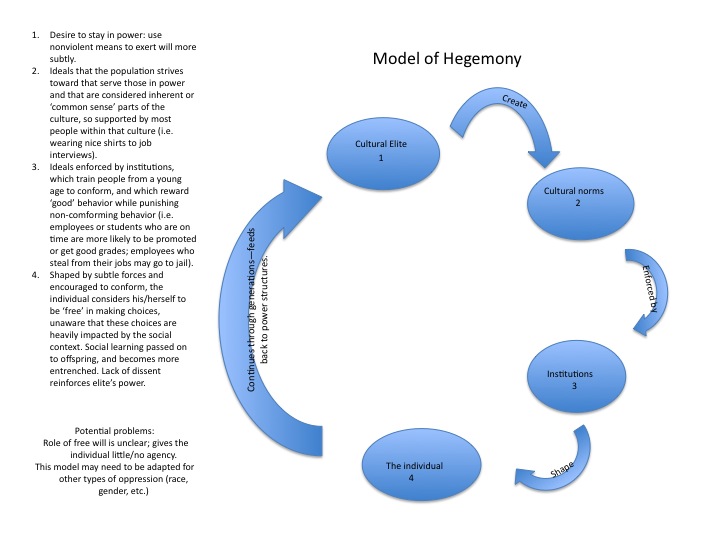
Visual Model of Hegemony

I am taking an LIS theory class this semester, and since we could use just about any theory we wanted (which would be hard not to do, given how interdisciplinary our field is!) I decided to go with the theory of hegemony. I’ll spare you the contents of my papers on the history of the theory and just focus on the model here (if you’re curious, the International Gramsci Society has some good resources, and I’m more than happy to share citations and such with anyone who has questions).
One of the reasons I love the theory, and the main reason I chose it, was that it was created by Antonio Gramsci, who started out in academia then left that life to pursue another career (as an activist). I feel like having both those perspectives and types of training informing one’s work makes for much more well-rounded scholars and keeps us from being so trapped in our own little world that we can’t easily engage with the world around us. I wrote a post on how my experiences in the service industry have shaped me as an academic that talks a bit more about this. I also love how the theory has been applied to so many research questions and types of inequality across many different fields, which shows its usefulness but also made it a bit tricky to pin down and define in a short paper. I tried, and I came up with this model that I wanted to share. It’s the first model I’ve made, so I suspect it’s far from perfect, but I would love to hear what you think–what looks good? What might I consider changing? Are there things you would add/take away? Major points that were missed? Would the model look the same for all types of inequality?


The model is held under a Creative Commons attribution-noncommercial 3.0 unported license (just like the rest of the site). Please share it with colleagues/students/whomever, just give me credit if you do!